Showing posts with label Future Cities. Show all posts

Tuesday, 25 March 2014

Geo: The Big 5 - Future Cities Story

As promised here is the Future Cities side of the Geo Big 5 write up. The content was kindly provided by our events group manager Rollo Home, I have done some reordering so any comprehension issues are probably my fault.

Glasgow Future Cities Team
The event was opened with a short but well aimed introduction from Councillor Gordon Matheson (leader, Glasgow City Council) who congratulated the AGI on reaching 25yrs "and looking good on it". He stressed the council’s commitment to opening up their data to public access through the portal where 85 data sets are currently published (including planning applications) including data from Ordnance Survey and the MET office. The focus is very much on putting the data into the hands of the citizen, as seen in the example of the customised city dash-board. The Councillor was keen to stress that while technology is great it is simply an enabler and it is the approach and political will that is the key. Glasgow have a clear desire to be a global reference point for future cities.


Andrew Collinge (Assistant Director, Greater London Authority) gave the first key note for the day, and started by outlining how “City Thinking” was now en vogue and thus he’d stress that it wasn’t the case of London vs. UK as currently being portrayed in the media, but “a Tale of, well, lots of cities” each emerging. However London is large, with a population that will exceed New York’s by 2016. Like Glasgow, London has embraced open data, and the portal drives 20% of traffic to the Council site. He then went on to give an example of some of the challenges London faces: 400K new jobs are needed, 40K new homes will required and 4,000 extra classrooms. One practical solution that the Future Cities approach has provided has been the School Atlas that allows authorities across London to see classroom provision and demand and plan accordingly, in the spirit of open data this is a public facing site.
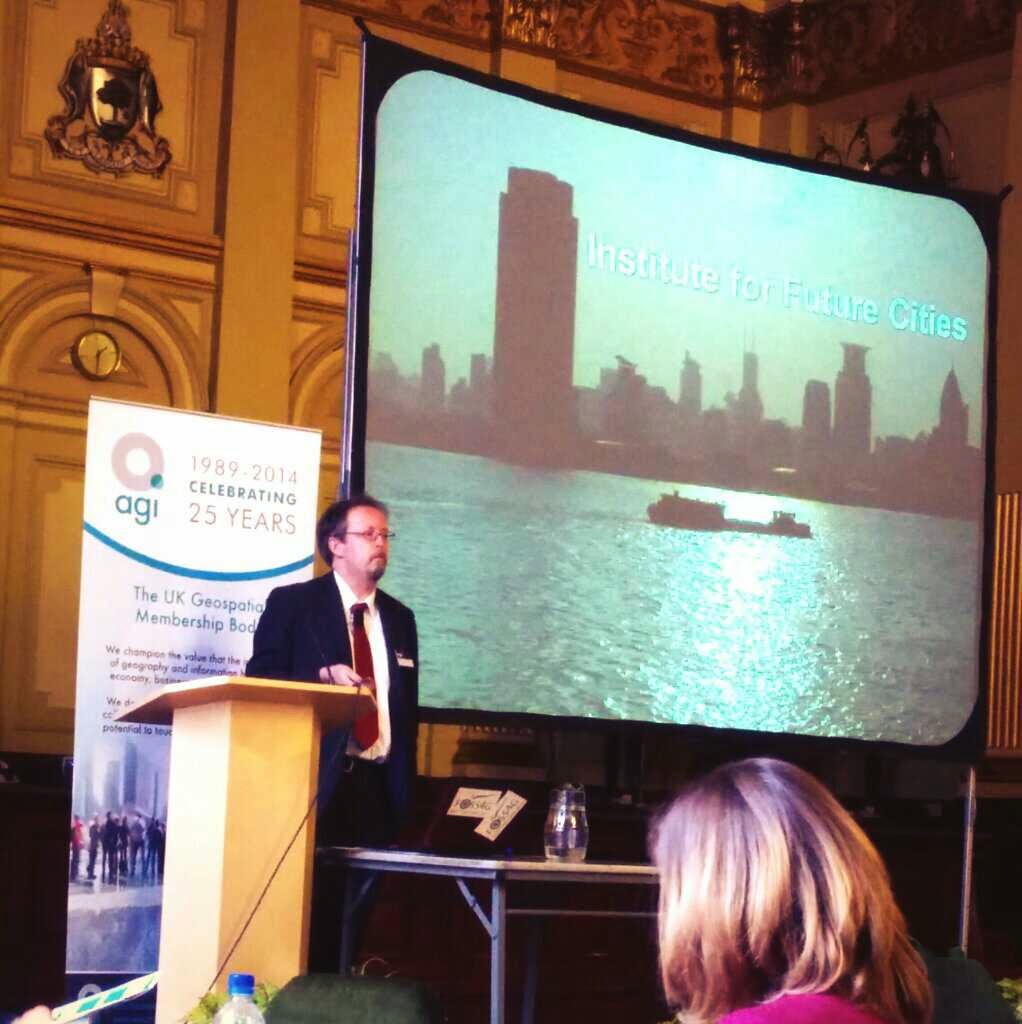
Institute of Future Cities
An interesting point made was that these problems have not just be realised – the concept of Future Cities was identified by 50 urban scientists meeting in 1960's US and outlining the issues of 'regeneration of cities needed to keep pace of demand’.

The plenary led into the Future Cities Steam which was chaired by Graham Colclough. A surprising thing about these sessions was the strength of continuity of the message between speakers. There was limited disagreement about the scope and scale of the problems being addressed by the Future Cities concept nor, the fact that location based data had an important role to play in tackling these problems. What was perhaps more surprising was that the focus of the discussions was entirely on the value of using geospatial thus we did not hear about how an application was developed and deployed, but about the reasons that they were developed, the success of the uptake, and the outcomes.

Steven Revill (Future Cities Glasgow) started the Future Cities session with a fuller review of the work already referenced by Councillor Matheson. The Open data market to “empower Glasgow” was a prominent thread of the discussion. This was achieved through the web portals and out outlets such as the My Glasgow Apps. In regard to adoption of the services, Steven reflected on how useful the branding had been to engage to younger audience, as was the premise of presenting data stories. The platform itself is developed quickly with releases often made in an attempt to maintain momentum to the project. The search for new data is on-going with GCC energy consumption of all public sector and education buildings being the latest. This has enable people to scrutinise energy use putting buildings that use excessive energy in the public eye and driving change

A question from the floor raised the issue of data quality. Apparently operational data from GCC is good, but there is discrepancy and an issue with completeness. However publishing the data is helping address and potentially resolving this problem. Making it public is driving a change in behaviours.

Dr Diarmad Campbell (British Geological Survey) had a very different focus, and that is the sub-surface. BGS have an Urban Strategy for the simple reason that 80% of the population live in such areas, and therefore the activity that requires geological analysis (structures) is concentrated in these areas. While internationally other cities such as Oslo and Amsterdam have huge investment in understanding the underground, in the UK there has not been such a history of investment. BGS are now working with GCC to produce a complete and detailed model of the sub-surface. Many urban areas, not least Glasgow have a complex sub surface environment from legacy industry as well as industrial processes and BGS are driving towards multi channel data availability to allow for better provision and better decision making.

George Kirk from Scottish Power Energy Networks discussed integrated energy planning, that is dealing with power from station to the plug. He explained how low carbon is a key part of Glasgow City development but has so far no being tackled fully. Previously there has been no shortage of data, but a limited understanding of how we use that data to make decision. Now there is an opportunity to inform the profession and public alike through visualisation and data availability

The afternoon session moved the focus of the discussion from Glasgow and the UK to the global context, and this was kicked off by Richard Bellingham (Institute for Future Cities, Strathclyde University) by presenting the issues of the changing world and in particular a growing and aging urban population. These are challenges that cities have no control over but cities are required to respond to them.

The scale of the problem is immense, billions of people moving to cities in the coming decades – which are creating patterns of mega-cities across the world. However we have to consider that this migration is a voluntary process. Cities are desirable places to live. They also act as engines for economic development and offer a solution to our energy crisis in that they are also more efficient per head on almost every measure.
Teresa and the Future Cities Catapult

Finally Teresa Rico Gonzales (Future Cities Catapult) rounded the session off with the work that the TSB is funding through the Catapult in order to mitigate the vast challenge of rural to urban migration. However she was keen to stress that the FCC is not reinventing the wheel but looking to utilise the expertise that is out there and enable collaborative creation of the solutions, a common them across the afternoon’s speakers.

The motivations of the FCC are focused on particular outcomes; the primary is a duty of care (as a remit of the TSB funding), but other more tangible (and commercial) targets are related to generating exportable urban innovations, growing UK market share of the global Future Cities potential and to build a world-class urban cluster.

The session was rounded up with a panel discussion led by Graham Colclough with:

The Panel
Richard, Teresa, Diarmad, Steven and Rollo Home on the stand. Graham encapsulated the discussion as revolving around two basic principles of information/data and collaboration which was re-iterated by the panel speakers, but each presented their own perspective on the problem with the Ordnance Survey and BGS looking at this from the position of having data to offer but needing to work with cities to understand the nature of the requirement, and with cities working with academia to understand the actors driving change and their requirements for data to monitor and support those agents. 

Thursday, 20 March 2014

Geo: The Big 5 gets underway!


Not a bad turnout...
Yesterday AGI Scotland hosted Future Cities the first of the Geo Big 5 events series and I'm pleased to say that we've got off to a flying start. Delegate turnout was at pre recession levels, the speakers were fantastic and the venue was pretty spectacular (thanks to Glasgow City Council for that one). Both streams had a really solid line up of presentations and the panel debate in the afternoon was really well received (those can be tricky to pull off).

I spent the day room monitoring in the best practice stream so I will be getting one of my colleagues to write a summary of that soon. In the meantime this’ll be a brief round up of the sessions I saw which included some great pieces of innovation.

The event opened with some very encouraging comments from the head of Glasgow City Council, showing that the local authority has really understood the power of GI to improve services for the citizen. However I will let my colleague cover this more within the context of the future cities stream.

The Main Room/Palace
The morning best practice stream opened with a presentation from the Forestry Commission Scotland on releasing a Scotland wide dataset on native woodland. This was quite an ambitious project in scope with the whole of Scotland surveyed over a period of about six years (some areas surveyed in greater detail based on aerial imagery). After collecting this huge dataset the team then overcame a number of challenges to provide this as open public data easily accessible to non GI users.

This was followed by a very nice presentation/demonstration from Paul Clarke of Esri on designing the future city. This showed City Engine being used on a range of projects as well as a general view on what future cities may look like. Paul also echoed the councillor’s comments about when talking about future cities it is what we are doing today that will define how they look and work.
The following presentation on the use of GI to support the Commonwealth Games in Glasgow gave a very practical demonstration of the challenges a modern city faces and the tools we have to overcome them.

After lunch the best practice stream kicked off with a really interesting project from Ross McDonald and Angus Council. They had successfully evolved their geospatial offering from a truly Byzantine collection of different platforms, datasets and file types into a much more open focused and integrated set up. This has allowed them to free up powerful but expensive proprietary software for users who most need it whilst spreading the power of spatial much wider across the organisation. Their mantra appropriately is ‘spatial isn’t special, its core’.

A presentation by ERM showcasing the use of GI for environmental and social management of major projects was up next. A particularly interesting feature of this solution is that it is accessible via the web and allows users (such as local residents) to comment on features of a project.

Last but not least Scottish Water and Kemeling Consulting presented on an asset visualisation project they have been working on. This project allows much better visualisation of sections of the Scottish Water network allowing the double benefit of improved repair efficiency and also improved transparency with local communities as to why work is being undertaken. The project has so far informed around £1 million worth of repair work.


An overall theme coming out of this stream, particularly the afternoon sessions was that the next step for cementing the role of spatial is to be able to articulate hard financial savings from projects such as these. All the users know there was benefit and the challenge is to be able to express this financially, something that is particularly crucial as the use of spacial spreads into the private sector.

Monday, 10 March 2014

Future Cities – It’s Nearly Time


We’re living in a time of rapid urbanisation, where shifting global demographics (growing in number, age and prosperity as they migrate from rural to urban life styles) are going to have an increasing impact on our activities here in the UK. For London, the population will grow to 9M by 2021 and 10M by 2030. That brings with it considerable pressures – for example, the need for 800K extra house units, capacity for an additional 600K peak-time commuters, and the challenge of dealing with the increased waste and energy consumption.  The Future or Smart City is the collective response to these immense challenges. It is not one thing or one technology, but a proactive approach to managing the urban infrastructure to provide a better level of service and living with less available resources.

It’s just over a week to go until the first of the Geo Big 5 events. This will be the Future Cities conference hosted by AGI Scotland in Glasgow. We’ve got strong delegate numbers and are still getting sponsors joining at this stage. More importantly (to our delegates anyway) we have a great line up of speakers which can be seen here.

Professor Iain Stewart
Highlights from this include a plenary from Professor Iain Stewart, BBC staple and geologies’ ‘rock star’ (Not my pun). In the Future Cities stream we have presentations from the Greater London Authority, the Glasgow Future Cities team and the Institute for Future Cities among others. The case studies stream has some great projects from geospatial in Scotland including the Forestry Commission and the Commonwealth Games (quite appropriate as today is Commonwealth Day). The Future Cities stream also includes a panel debate with some of the day’s speakers and a few special guests.

Anyway with all that in mind I thought I’d give a quick background on Future Cities and why we have picked this as one of our big 5 for 2014.


Andrew Collinge
Andrew Collinge - Greater London Authority
This event, being held in the impressive Glasgow City Chambers, will enable delegates alike to come away with a renewed appreciation of how Geospatial Information and Systems (GIS) can contribute to overcoming the barriers of a City becoming a Future City. To understand a modern city is to understand how its occupants utilise the space over time. However much of the discussion around future solutions to meet the increased and changing demands being placed on a city, are not addressing the inherent geographic nature of the problem. This is perhaps being exacerbated by the GI industry not sufficiently articulating the benefits it can bring. This events aims to provide an awareness to all attendees of the opportunities offered by making GI an integrated part of the Future Cities solution.


It’s going to be a great event and a must attend if you are interested in Future Cities, you can book here. Flights to Glasgow are still pretty cheap and it’s only £49+VAT for members.

Thursday, 6 February 2014

Call for Papers and Geo: The Big 5

The call for papers for Geo: The Big 5 is now open and we have already received a number of abstracts. However it has emerged that there is some confusion over what can be submitted and where and just as importantly who selects it. The idea of the submissions page on the website was to keep things as simple as possible as it has been suggested that the somewhat convoluted admissions process has put people off in the past.

The first point to note is that we are running the call for all events at the same time so if you have a paper that you would like to present at the Big Data event in September you can send it in now.

Secondly it is very important to reiterate that there are two streams at each of the single day Big 5 events (more at GeoCom) and this is reflected in the call for papers. Each event has a theme (Future Cities, Open Geospatial etc) and we welcome paper submissions under the relevant theme for each event. This will take up one stream at the event designed to cater for a UK wide audience. The selection of papers for this stream will be undertaken by the events Action Working Group (AWG) with advice from relevant SIGs.

The second stream at each conference will consist of case studies and best practice from the wider field of geo that are of interest to the local area (and we’re taking a broad definition of local here). For example for the Future Cities event in Glasgow there will be a second stream of content populated by case studies showcasing the work of Scottish organisation and at the Policy event in Wales there will be case studies form Welsh organisations and so on. The local National/Regional group will be heavily involved in selecting the content for this stream (alongside advising on the main stream). The ultimate goal being to have an event that is significant across the UK GI industry that also provides a forum for the constituent nations and regions of the UK to showcase issues and work that is of interest to the local GI community.

Finally if you have a great paper on Future Cities for example but can’t make the Glasgow conference we will also be carrying the Big 5 themes into the annual conference (along with some others) so you can always submit now to present it there. The GeoCom conference will be wrapping up the themes from the other conferences and the best papers from each of the one day events may well feature.


Basically we don’t want to put people off applying, the Big 5 themes are there to guide the debate through a series of exciting events not to be a barrier. If you have done something exciting and innovative in GI then the AGI want to hear about it and give you the chance to show it off to the wider industry!

Tuesday, 28 January 2014

Geo: The Big 5 - Launching our 2014 Events!

Last week we launched our main events series for 2014 titled ‘Geo: The Big 5’. This is a series of six national events (the five referring to the issues) made up of five one day events and the annual conference.

With this year being the 25th Anniversary of the AGI we wanted to ensure that rather than looking to the past we produced an event series that is tackling the issues in the industry today and looking towards changes in the future.

Throughout 2013 we held discussions with our members, SIGs, delegates at events and industry experts to help identify some of the top issues and challenges that the industry is experiencing today. We had great feedback on this and have managed to group most of these issues into the following five areas:

·        Future Cities
·        Open Geospatial
·        Big Data
·        BIM and Asset Management
·        Policy

Each of these topics will have its own one day event dedicated to it and have been chosen because they are nationally significant.

The first event of the series will be Future Cities and will (rather appropriately) be held in Glasgow, home of the Future Cities Demonstrator on the 18th March.
It’s important to note that we aren’t neglecting other areas of the industry and each conference will contain a strong second stream of content showcasing best practice and innovation beyond the main theme of the conference. The second stream in Glasgow for example will showcase great uses of GI from within Scotland.

All of these themes will feature in the annual conference ‘GeoCom: The Changing Face of Geo’. The new annual conference will serve to bring together the discussions from the other events and set the agenda for Geo going in to 2015 and beyond.

Plans are well underway with a number of speakers already lined up and a call for papers ready to go for what is going to be an exciting programme of events. Last year’s showcase events were a great success but we’re confident that this is going to be something a bit more special.

To book for any of the events click here


If you want any more information or are interested in volunteering with the organising groups for any of the events (or think you know a great speaker) then please get in touch! (chris.rhodes@agi.org.uk) 

Also as part of the new look events series we are using the lovely new logo you can see at the top and will be tweeting under #geobig5