Showing posts with label Geo Big 5. Show all posts

Monday, 22 September 2014

Volunteering with the AGI

Jeremy Hidderley - AECOM & AGI Events AWG


In our 25th year, the AGI has really pushed the boat out with the Geo Big 5 series of seminars.  The special interest groups continue to support the association with the provision of seminars with activities focused on specific subjects.

All of these events would not be possible without the support of a growing band of volunteers putting these events together with the support of the fabulous AGI staff.  This is a great method of working.  The volunteers (also members of the AGI) are able to set the vision for these events, and the AGI staff facilitate many of the volunteer requirements.  The volunteers benefit from a knowledgeable and hardworking support network.  The AGI, as an organisation benefit from the volunteers as they all bring something to the table.  

The benefits to the AGI typically fall into two camps:

  •         Ensuring that the AGI follow the correct strategic direction
  •         Making that strategic vision a reality

Whichever camp you think that you may fall into, the ultimate reality is that all volunteers are contributing to the community in which they are involved.  They are helping to share knowledge which should help everyone in their day to day jobs. 

The benefits of volunteering are not just one way, the individual can benefit greatly.  Some of the common benefits gained from any type of volunteering include:

  •          Gain confidence and self esteem
  •          Giving something back to a group that has supported you
  •          Sharing your own knowledge/skills
  •          Gain new or develop existing skills
  •          Help to gain/maintain accreditation (CPD)

Particular attention should be paid to the benefit of gaining accreditation.  As a prospective and qualified Chartered Geographer, individuals should be demonstrating an ongoing commitment to promoting geography.

In the run up to the conference in November 2014, we are starting to look to fill our volunteer roles.  So if you are attending the conference, please do take a look at the AGI’s Big 5 Volunteering website (http://geobig5.com/volunteer-job-descriptions).  As a conference volunteer you will benefit from building a strong network of industry peers, some of whom may sit outside of your normal group of contacts as well as helping to influence how the conference looks and feels. 

Whilst some of our roles do require a minimum time commitment, these are normally short term or one off roles.  If you would like to volunteer on a more flexible basis, please do get in touch, as we are starting to look for Working Group members for 2015 and beyond.


We look forward to hearing from you.  

Monday, 15 September 2014

The AGI GeoBig 5 - Policy


Policy! Policy! Will anyone come along?

Well that was the first reaction from the AGI Cyrmu steering group when we discussed this theme for our part of the GEO Big5 programme. Compared to some of the slightly more sexy themes on the agenda we thought it would be an uphill struggle to deliver a stimulating and appealing day. 

How wrong we were.

As we got into the topic and considered both its significance to what we all do and the varying aspects for how we could run an engaging and exciting day we quickly found out a number of really interesting themes that we could focus in on for an interactive and lively GEO; Big5  event. 

Policy affects us all. Sometimes we moan about it and it seems overcomplicated and a burden. At other times it’s exciting and innovative and it moves us all forward in our jobs. The GIS community has to interpret policy, advise and convince management what the best options are for its adoption. Suppliers develop solutions to help people implement and comply with policy– a challenge as guidance never stays still! Then there is the effect GI has in shaping policy itself – location is a fundamental principle in helping to draft, deliver and measure the benefit of policy. There is also the policy of GI itself.

So at first what seemed a topic that would send us all to sleep has made us all think and got us really excited as we have put the programme together.

The AGI Policy event is certainly fast approaching, and scheduled to take place on 9th October at the SWALEC Stadium, Cardiff.   The event is sure to attract a variety of public and private sector delegates as well as several exciting exhibitors, including our Platinum Sponsors Ordnance Survey and ESRI UK.  Following some great keynotes, the day will focus on the relationship between Policy and Geospatial with a split stream session of “Policy influencing GI” and “GI Influencing Policy”.  The afternoon sessions includes a series of lightning talks and a highly anticipated GI Interactive group event which will provide voting, networking and debating opportunities about some of the issues you should really care about.

Directly after the event will be a tips and tricks session, where you may find yourself learning some new skills and getting some value you can take back into your organisations and implement straight away.

If you want a bit of an ice-breaker before the event, come and join us at Y Mochyn Du pub at 7pm on 8th October for a drink!

The AGIC Team

View the event programme here

Platinum Sponsor Comments:

Esri UK is delighted to sponsor the GEO: The Big Five Policy event in Cardiff on 9th October. Esri UK is committed to helping organisations across the public sector meet the most pressing policy challenges and implement government priorities – giving the geographic insight needed to make better decisions.  Esri GIS solutions help the public sector enrich operations, meet missions and better communicate with the public.

For further information on how Esri UK supports Government Policy, email info@esriuk.com or visit www.esriuk.com/government .


Ordnance Survey is proud to sponsor the GEO: Big Five Policy event in Cardiff on 9th October. Through the Public Sector Mapping Agreement (PSMA) we are already supporting the majority of Welsh public sector organisations in identifying efficiencies and cost savings in policy creation, monitoring and delivery. We would like to ensure this opportunity is exploited by all our public sector customers and look forward to discussing how we can work together to make this happen.


Thursday, 11 September 2014

AGI announces Professor Iain Stewart as Guest Compère at its annual awards evening - 13/11/14.


The Association for Geographic Information (AGI) is pleased to announce Professor Iain Stewart as Guest Compère at its new annual awards evening – The AGI Awards for GeoSpatial Excellence -  to be held at the Chesford Grange Hotel, Warwickshire, during the evening of November 13th 2014.


The AGI Awards are a prestigious event recognising the very best achievements in the field of Geographic Information throughout the year. The purpose of the awards is to recognise excellence within the industry and to foster a spirit of innovation to the betterment of Geographic Information in the UK. This year marks the 25th anniversary of the AGI and as a result the AGI has launched an exciting new set of awards for 2014 and beyond! The AGI Awards for Geospatial Excellence move beyond the traditional sector based approach to generate an open and engaging competition for each award relevant across the whole industry! For more information about the awards and how to nominate yourself or your project please visit: http://www.geobig5.com/events/agi-awards-geospatial-excellence/

The deadline for nominations is 30th September 2014.

About Professor Iain Stewart:

Iain Stewart, professor of Geoscience Communication at Plymouth University (UK), is an Earth scientist and broadcaster who specialises in recent geological change. He has presented major television series for the BBC on the nature, history and state of the planet, most notably ‘Earth:  The Power of the Planet’; ‘Earth: The Climate Wars’; ‘How Earth Made Us’, ‘How To Grow A Planet’; ‘Volcano Live’, and ‘Rise of the Continents’. He regularly fronts BBC Horizon specials on geoscientific topics, such as the Japanese earthquake, the Russian meteor strike, Shale gas/ Fracking, and Florida sinkholes. In 2013 he was awarded the American Geophysical Union’s Athelstan Spilhaus Award for conveying to the general public the excitement, significance, and beauty of the Earth and space sciences.


Thursday, 21 August 2014

Geo: The Big 5 - News Round-up

Big Data (IBM, London, 30 Sep) in Partnership with the Demographics User Group – programme online, book now!

There is still chance to book a place for this highly anticipated event and gain insight into one of the hottest topics in future IT thinking. The AGI’s Big Data event features world leading experts from big data (IBM, Cloudera, MapR, Deloitte), major commercial users (Marks and Spencer, Telefonica) and geospatial sectors (Esri, Ordnance Survey). Two parallel streams will run through the day, one focussing on Strategy and the other Best Practice. The conference is accompanied by an exhibition and the full programme can be viewed here.

Geocom - The Changing Face of Geo (Chesford Grange Hotel, Kenilworth, 11th-13th Nov) - early bird ends 12th September

This year’s new format Geocom (marking the AGI’s 25th year) will see talks from leading industry speakers and Government Chief Scientific Adviser Sir Mark Walport. Talks will explore the challenges, opportunities and business benefit of integrating geospatial with a host of other tools alongside skills focused workshops, hands on training and an innovation theatre. Regardless of your sector or interest GeoCom will allow you to debate, engage with and shape the future of the geospatial industry. Logistics information and the conference registration form can be found online.

 AGI Awards for Geospatial Excellence (Chesford Grange Hotel, Kenilworth, 13th Nov) - still time to gain recognition for your work


There is still plenty of time to submit an entry for the AGI Awards for Geospatial Excellence and be recognised for your achievements in and commitment to geospatial in 2014. Detailed descriptions of our ten prestigious awards are available on the Geo Big 5 site

Thursday, 7 August 2014

AGI Awards for Geospatial Excellence – why you should enter, sponsor & attend


There is still plenty of time to submit an entry for the AGI Awards and be recognised for your achievements in and commitment to geospatial in 2014. 
Ten prestigious awards (new for this year and beyond) will recognise excellence in visualisation, education, research & development, business benefit, impact and sustained commitment to geospatial. 

Reflection and celebration is not often at the forefront of an employee's to-do list; award entries take time and effort (though the AGI's entry form really is quite concise) and other deadlines will often take priority. However, awards are an important way of acknowledging achievement and commitment. The AGI awards aim to inspire through showcasing the very best practice in the geospatial industry, fostering a spirit of GI innovation in the UK.


This post details a plethora of reasons to submit an entry for, sponsor and attend the 2014 AGI Awards for Geospatial Excellence: 

Why Enter?

  • Obtain recognition of your success among your industry peers – being shortlisted for an award will raise your profile among the most renowned names in the industry
  • Showcase your company at one of the UK’s biggest gatherings of GI professionals
  • Demonstrate your company’s success stories to prospective clients – the awards are an opportunity to prove that you are at the forefront of the GI market
  •  Keep an eye on the competition - the awards are a great opportunity to measure your own performance against your competitors’ and see where you sit alongside the best in the industry
  • Share your stories and excellent case studies of exemplar projects to help the AGI to sell the value of investing in geospatial to a wider audience.

Why Sponsor?


  • Showcase your company at of one of the year’s premier geospatial events and position your company as a market leader
  •  Stand out from your competitors with branding throughout the conference and ceremony
  •  Differentiate yourself from competitors by demonstrating your support and commitment to the GI industry and its achievements
  • Participate in the judging process and present an award on the night
  •  Benefit from visual marketing at the event and coverage in the AGI Geocommunity Brochure.


Why Attend?

  • Learn about the projects which your peers and competitors are undertaking - see state of the art projects and learn from the entrant’s experiences
  • Network with Geospatial leaders from a range of sectors and network in a relaxed environment
  • Celebrate the industry’s success with clients
  • Establish face to face relationships and create new business opportunities
  • Reward your team with a glamorous night out
  • Meet our distinguished panel of judges.

Diamond Sponsors:


Awards Sponsors:


Wednesday, 16 July 2014

Getting Ready for Summer at the AGI

I've managed to find time from website specs, CRM user stories and PR plans to write the first blog in ages. It’s very very warm in the office which must mean it’s nearly time for the summer holidays so before everyone disappears to somewhere exotic and exciting I thought I’d give a quick preview of what you’ve got to look forward to when you come back.

GeoBig 5 - Big Data:
The next of the GeoBig5 events is looking at big data from both the perspective of how technologies and practices can and are impacting geospatial data collection and analysis and the opportunities provided by so much big data containing a geospatial element. The full programme will be released next week for what’s going to be a great event at the IBM hub in London on 30 September.

GeoBig 5 - Policy:
The final one day event of the GeoBig5 series will be exploring both the implications of policy on geospatial (INSPIRE, Open Data etc) and also the positive impact geospatial can have in informing policy decisions. The call for papers for this event closes on the 1 August so there is still time to submit. The event takes place in Cardiff on 9 October.

GeoCom ’14:
The culmination of the fantastic GeoBig5 series. Having been at the recent planning meeting and paper selection for this event I can safely say GeoCom ’14 is going to be something special and unlike any previous AGI conference. As well as having secured Sir Mark Walport (Government Chief Scientist) as our keynote we’ve got a mixture of presentations, lightning talks, workshops and training that will make the whole conference a lot more vital and dynamic. GeoCom ’14 takes place between the 11 and 13 November at the very pleasant Chesford Grange Hotel, earlybird booking with a 10% discount is still open.

Awards:
The final event of the year and a fitting end to 2014 will be the new AGI Awards for Geospatial Excellence. Replacing the previous AGI awards these will take a much broader and more outward looking view of the industry to promote and recognise excellence and innovation. Compared by TV’s Professor Iain Stewart (A great evangelist for the power of Geography and GI) this will be a great showcase for the industry and a chance to see some of the great ideas from 2014. This will take place on the 13 November at the Chesford Grange Hotel following on from GeoCom. Awards submissions are still open.

Website:
The project that has been absorbing my blogging time is well underway and the new look AGI website should be greeting our members as they return from their summer holidays in September. Complete with content hub, best practice documents, space for SIGs and other AGI groups to interact the new site will provide both a showcase for the AGI and UK GI and a resource and benefit for our members.

And Finally

It’s hot, the evenings are bright and we’re not quite ready for summer yet so why not come along to the next AGI Geodrinks on the 23 July? These are being hosted by the Insurance and Risk SIG at the Crosse Keys (extra e not a typo) on Gracechurch Street, London. Its an Insurance and Risk event but other Geo talk is more than welcome!

Tuesday, 17 June 2014

Big 5, GeoCom and the call for Abstracts – Why you should submit!

Over half of the one day Geo: The Big 5 events have taken place now and the feedback from delegates, sponsors and speakers has all been excellent. The themed events have really added a new dimension to the AGI programme and have catalysed debate and the debate is changing.

A common point that has come through all of the events so far is how interconnected all the issues are and how collaboration of ideas and technologies across sectors is key to furthering the positive impact geospatial can have. Related to this is in increasing feel the GI and geospatial have gone ‘mainstream’ to the point that many people using these technologies and techniques don’t even realise that is what they are called. GI is just one of the tools businesses, governments and other organisations are reaching for to help them make better and more efficient decisions.

This growth bring a whole host of challenges and opportunities and massively increases the audience for whom GI is relevant (whether they call it GI or not). GeoCom will seek to tackle this head on with varied content from that aimed at policy makers with no technical experience to workshops seeing to grow practical GI skills.

Get Involved!

The call for abstracts for GeoCom ends on the 30 June and I cannot stress strongly enough that this is your chance to get involved in the debate! There are crucial conversations to be had and you can help frame the debate by speaking at one of the events. The submissions process is simple this year and all you need is a short abstract (more details here). With shorter and longer presentations, debate sessions and workshops there are more ways to get involved in the most interactive GeoCom ever.

The call for papers for the remaining Geo: Big 5 events (Big Data and Policy) is also still open with deadlines of 20/06 and 01/07 respectively. This is a great chance to influence the debate at the last two events of this exciting series. Both of which will help to inform the discussion at GeoCom and the AGI Foresight Study for 2015.

Don’t forget you can also submit your paper to be considered in the AGI Awards for Geospatial Excellence taking place at the end of GeoCom.

Come Along!

Obviously we also encourage you to come along. With early bird prices from £290 for two days packed with content, debate and workshops (as well as networking and the exhibition) GeoCom represents great value and a very different event to last year. You can view details and book here.


With presentations ranging from the technical to the strategic there will be content for ‘hardcore’ GIS users as well as strategists, CIOs and the like so if you are a long suffering GI manager drag your boss along to reinforce the value of the expertise you provide!

Thursday, 22 May 2014

Geo: The Big 5 - Open Geospatial Review

Simon Wheeler, AGI NI Chair and the person single most responsible for making the latest Geo Big 5 event a huge success has kindly provided a review of the event:

Last week saw the 2nd Big 5 conference “Open GeoSpatial” hosted by AGI Northern Ireland. When the new format was suggested at the end of 2013, this was the theme that most excited me, and it has been great fun, and hard work, to help put the event together. Post event it has been deemed one of the best events we have hosted since AGINI started 11 years ago.
Opening the Debate

The Big 5 events can be summed up as AGI Conferences in the Regions, rather than Regional Conferences as the Nation groups have held previously. So what did this mean to us in Northern Ireland? The format effectively gave delegates a taste of what they might expect at the main 2 day conference (up to now known as GeoCommunity or GeoComm). We had big name speakers, 2 streams and hands on workshops, as well as the Sponsor exhibition. However, what made the event a game changer from my perspective, was the mixture of delegates attending, with a good mix of attendees from Northern Ireland, GB and the Republic of Ireland, with 2 of our speakers (Australia and Canada) giving it a truly international flavour – brought out in the panel discussion where we had 6 nations represented, with the myriad of views aired.

OK – what did delegates get on the day? Following my opening as AGINI Chair, Anne Kemp (AGI Chair) gave a brief summary of the Open Standards panel debate held in London the day before. We opted for 2 keynotes this year – Caron Alexander the new Director of Digital Services for the NI Civil Service gave her view and vision for Open Data in Northern Ireland. There are some exciting things to come and I am really looking forward to what this can bring to the Industry. She also announced a Head of Open Data has been appointed – a good move so said the #GeoBig5 tweets. Then Jim Lennon gave a quick update on the new LPS (OSNI for the old hands) data model, and Spatial NI, the Northern Ireland Inspire and spatial data portal to be officially launched on the 4th June. The brief tale of how the major snow storms of March 2013 brought Spatial NI to the attention of the emergency planners was a great example of how a crisis can raise the prominence of Geo.
Estelle Lowry  about NINIS 

After the much needed coffee break (the opening coffee somehow appeared as the conference started), we split into two sessions plus a workshop. The main stream covered the broad Open themes – Standards, Data and Source plus what the AGI brings to the table – Open debate, whilst stream 2 covered case studies, but still largely around the Open arena. I stayed in the main session to help Bruce McCormack, our guest chair and President of IRLOGI and EUROGI, to host the stream. For me it was a major coup to secure Denise McKenzie from OGC to speak on the common sense and value of standards internationally. Standards allow us to communicate with each other digitally, and work best when open. Following Denise, John Carpenter from Ordnance Survey GB took us through the value of Open data to OSGB, and also some of the issues around the need for API’s and assistance to developers to enable them to be used effectively. Bill Roberts of Swirrl then gave an overview of Linked Data and the benefits which it brings to connecting data together. Stream 2 had some great talks from the feedback I got, with Ciaran Kirk of IMGS talking dynamic data, Brendan Sheehy of Mallon Technology looking at the benefits of Open to SME’s and Jo Cook of Astun Technology talking QGIS in the Enterprise.

Following a busy lunch (some WIFI issues to solve), we were into the 2nd part of the split stream. OSGB delivered a great workshop on OSGB open data using QGIS, which had followed a very packed morning workshop from ESRI on Story maps and flex viewers. Where else can you get industry experts giving workshops for free? In stream 1, Eoin McFadden from DETI looked at how open public data was being
The Panel, Deep in Debate
used as a driver for innovation, and how Northern Ireland is at the forefront of this drive. We then had an extended international panel session chaired by Bill Roberts with some thought provoking questions for Anne Kemp, John Carpenter, Tracey Lauriault, Denise McKenzie, Eamon Doyle and Eoin McFadden. Sadly we had to cut it short at 1 hour – we could have gone on much longer – the session is available on the AGI site. The best practice stream meanwhile heard from  Eamon Doyle of ESRI Ireland, Rosita Mahoney of the SPACEial NW project, Estelle Lowry of NINIS and John Hewitt from SOPRA.
I asked one of the delegates who was new to GI and AGI to give his perspective on the day.  Paul Higgins from LPS Business Services gives his perspective on the day.

“Three years ago I didn’t really know much about GI, but over the last couple of years through work and media I have become increasingly aware of it. I just didn’t know it as GI. So I went along to the conference to learn and understand how GI could be of benefit. I went to the Open Data stream in the morning and to the Best Practice Showcase in the afternoon.
I was motivated by Denise McKenzie’s talk. I had a Health IT background and could see lots of potential for GI. For example epidemiology and GI are made for each other.  I also found it refreshing that it all speakers were advocating open data.
The Best Practice stream put into perspective the Open Data stream. Eamon Doyle from ESRI Ireland described his ‘Road to Damascus’ moment.  I think I had my moment at the conference.
I came away from the conference inspired and with a much clearer vision of GI and its potential. It occurs to me as someone from a mainstream ICT background, and new to GI, that it is going to be a growth area in the next few years as ‘big data’ becomes more prevalent. As all the latest technologies such as Internet of Things, Remote sensing, wearable technology and GPS mature, the only way to make sense of it all is through GI. So I am glad I went to the conference.”


Finding out how Canada does Open

To wrap up the day, we welcomed our plenary speaker Dr Tracey Lauriault, a prolific Canadian open blogger who is presently based at NUI Maynooth working on the Digital City programme. Tracey gave us a whirlwind tour of what we can learn from the Canadian experience of Open – standards, SDI’s and the role of the Geomatician. Tracey has huge amounts of energy and was a great end to the conference. Well not quite the end – this came with GeoDrinks when I finally got a chance to catch up with colleagues old and new.

So if you haven’t been to a Geo Big 5 event, there’s still time – it’s a great programme of events and well worth attending. Whilst it’s a great place to network and make new contacts, these conferences are also a great way to get a synopsis of what’s relevant at the present time from industry experts. You will always learn something new, or get a new perspective.
A big thanks to all our speakers and sponsors once again.

Tuesday, 29 April 2014

Why you should attend Geo: The Big 5, Open Geospatial

There are only two weeks to go until the next Big 5 event Open Geospatial takes place in Northern Ireland 
and it’s definitely time to make a really clear case for why you should attend. I normally consider lists the epitome of lazy writing however in this case I can’t think of a better way to put it so here are 5 (or 6) reasons that we should be seeing you in Belfast on 13 May:

1. Whoever you are, wherever you are Open matters and is not going to go away
I have written about this before but time to restate it quickly. Open Geospatial impacts the whole industry; whether as a provider you are helping implement or competing with open source products or if as a user you are looking to utilise increasing amounts of open data (or as a data owner trying to open up your data). How the challenges and opportunities provided by open are tackled by the industry will have a huge impact in the future. A lack of standards, poor practices and a move back towards restriction could all have significant implications for the role of geospatial over the next 15 years. That is why it is important to get involved in the conversation now.

2. We’ve got a great programme of speakers
Following on from the above point we’ve got a great programme of speakers who will be tackling the pertinent issues in Open Geospatial. These range from high level industry insight and overview such as ‘open public data as a catalyst for innovation’ to more specific detail on topics like linked open data and the need for ‘geomaticians’. The day also includes a panel debate from some of our speakers allowing you to take part in the conversation.

3. Keep up to date with workshops
Need to convince your boss why you should be out of the office? How about a hands on intro to Ordnance Survey’s open data using QGIS or some open source apps from Esri? We know that workshops are always popular and are making sure we include more of them in the Big 5 event series.

4. Be part of a bigger response
This event is part of the wider Geo: The Big 5 series and the conversations that come out of it will be helping to inform the AGI's response to the issues of the day. The need for standards in open, the power and potential of opening up public data, enabling collaborative solutions to problems; these are issues where you can help us form our voice. Many of the discussions from Future Cities are coming up again as we draw up the programme and it is this chance for interlinked thinking that needs to be harnessed to push the value of geospatial forward.

5. Join the conversation (networking)
As always this is a great opportunity to meet with your peers, discuss the issues at hand and meet customers or look for new ones. Networking is a key part of any event and we have networking time afterwards. If you are coming from outside Northern Ireland this is a great opportunity to meet a new GI community.

6. Its only £49!
Finally, it is only £49 for members (including IRLOGI members in the spirit of cooperation), this is really very cheap for a one day conference especially one packed with two streams of great content and workshops making it ludicrously good value.

Also if you’re not from Northern Ireland it’s a great chance to come and see Belfast at the same time as learning something/doing some business. For more information on getting too and staying in a rather excellent city have a look at the logistics pack

Thursday, 24 April 2014

Re-branding, Websites and GeoCom ‘14

I apologise for the sparse blogging over the past couple of weeks but I’ve been rather preoccupied with the three items above (and the other Geo: Big 5 events). The good news is that this work is paying off and we’ve made loads of progress to update people on.

First up is the branding, as many of you may have noticed (especially delegates at Future Cities) we have been working on a new brand. The old AGI brand has served well over the years but has become fragmented and a little dated over time. 

With the work being undertaken on a new AGI website we wanted to ensure that we had a clean and consistent new brand so this combined with the 25th anniversary seemed like the perfect opportunity to undertake a rebranding exercise.

 More information can be found here but we feel the new brand gives a very clear visual statement that the AGI wants to make sure that it is doing all it can to be relevant in 2014 and beyond. The new brand is much more than just a logo and will reflect how we communicate within and beyond our industry going forwards and builds on a lot of work that is being done behind the scenes as to who we are and what we stand for.

We have created a page with the various brand resources on which can be found here.

Next up and probably most exciting for most of you is the work being done on a new website. Our current website is a little dated to say the least and places a lot of limits on what we can do so the decision has been taken that rather than attempt to re-skin and tinker with it we are going for a whole new site. 

I am lucky enough to be one of the small group working with the developers on the new site and I can already say it is going to be a vast improvement. We want the site and the member’s area to become a content and knowledge hub for the industry and will be populating it with news, features, interviews and content from passed events among other things.

As always the success of this will depend on our members and we will be making it accessible for SIGs and other groups to edit and add content that is interesting to them. We welcome comments from members on what content they might like to see and also if there is anything they would like to contribute. The new site is expected to go live in late June but in the meantime we have launched an interim site just for Geo: The Big 5.

Finally we come to GeoCom – ‘The Changing Face of Geo’, the change in name partly reflects a desire to move from an inward looking community to an outward looking group engaging with wider industry and partly because everyone just shortened it to GeoCom anyway. We visited the venue at the start of April and it is fantastic and a very different space to the EMCC. Not only is it a very nice looking country hotel but it also has an awful lot of different meeting rooms. This is going to enable us to run a lot more workshops and hands on training sessions (as the majority of delegates have requested). As a result we’re going to be delivering a GeoCom that is a lot more varied than last year with the core focus being on getting really good content and speakers.

Anyway more on GeoCom will follow as we finalise the programme and the speakers but in the meantime have a look at the new brand and think about what you might want to see on the new website.

Friday, 11 April 2014

Sponsor Feedback and GeoCom '14 - David Henderson

David Henderson the AGI Vice Chair has kindly provided me with a brief report of our visit to the fantastic new GeoCom venue last week:

Along with the AGI Team and some fellow Council Members, last Thursday I attended a meeting of AGI Suppliers SIG at the Chesford Grange Hotel near Warwick where we will hold this year’s GeoComm conference on the 11-13 November. 

The meeting allowed some of our corporate members – 1Spatial, Dotted Eyes/MISO, GGP systems, Sterling Geo and Ordnance Survey – to give some further feedback to the AGI events team (this year chaired by Rollo Home) and for us to have a tour of the conference facilities.

Whilst the move away from Nottingham will bring some inevitable changes to the look and feel of our annual conference, I am really excited by the fresh new opportunities that Chesford Grange Hotel will afford to the event – the food was quite tasty too!!

At AGI we’re really excited about how our 2014 events programme has begun. You can read more about the fantastic success of our first event, hosted by AGI Scotland national group, in Glasgow last month. Members travelled from across UK to participate in some very high quality discussion and debate.  Our events programme complete with new branding and sponsorship opportunities can be found here.

We’re delighted that both ESRI(UK) and Ordnance Survey have committed to Diamond Sponsorship for 2014 and equally pleased to have agreed event sponsorship packages with so many of our other corporate members. Our 2014 event programme in particular has been developed in conjunction with our Suppliers SIG and is giving an important platform for the geographic information industry to discuss many of the big issues that are impacting and presenting opportunity for our members. Plans for 2015 have already started. If you’d like to get involved in any of our events or discuss sponsorship then the AGI Team or any member AGI Council would love to hear from you.

In the meantime, we look forward to seeing as many of our members as possible at the next Big 5 event in Belfast on 13 May.

Wednesday, 9 April 2014

Open Geospatial and why we should care

The next Geo: The Big 5 event, Open Geospatial in Belfast is approaching fast. I am not going to launch into a lengthy debate about Open Source vs Proprietary GIS systems or similar. This has been done to death and by people much better placed to talk about it than me.

What I will say is that this event is about much more than open source software and has a relevance to all producers and consumers of geospatial information. The full programme will be released soon but some of the highlights among the speakers include Denise McKenzie from OGC,  Eoin McFadden from DETI NI and Dr Tracy Lauriat from NIRSA (National Institute for Regional and Spatial Analytics) who is highly regarded for her work with open data in Canada.

Following on from the Future Cities event the increasing opening up of data and the innovation and benefit this can bring to both the public and private sectors look to be a key themes. Whilst increasing use of open data seems on the face of it to be more of a benefit to the public sector in enabling joined up thinking and better decision making this is of course a huge opportunity for companies to sell their expertise and help various authorities and departments make the most of their data.

The less glamorous but vitally important cousin of open data is open standards. We were recently lucky enough to have a presentation from the AGI Standards Committee in a recent council meeting and for someone who has always seen standards as rather dry this was a real eye opener. If as an industry and a society we are to benefit from the increasing availability of data we need to ensure data standards are applied and followed in as universal a way as possible. It would be a great shame to find that one local authority was making data available in a format that was incompatible with other authorities’ data or to find that a contractor was collecting data that didn’t match up with their other data sets (an all too common occurrence in the private sector). We want to ensure that open data is a methodology to break down silos not just create a whole host of new ones. Again this is likely to be very much on the agenda particularly the panel debate, with the conversation following on from an Open Standards event the AGI is holding in London the day before.

Open is important whoever you are in geospatial. If you’re a user of geographic information then come along and see how you can be getting the most from opening up your data and if you’re a supplier or consultant then you should be exhibiting and showing of how you can help the clients make the most of their data (and accumulate more and more relevant data).

You can book for the event here; it’s only £49+VAT for AGI members (which is very cheap really). Remember these are UK wide issues and Belfast is only a short flight from most major UK cities and it’s on a Tuesday so you can tack it on to a holiday, explore Northern Ireland and make a long weekend of it.

For our corporate members this is a great opportunity to get your expertise with open in front of an increasingly geo savvy public sector from across Northern Ireland and the Republic. You can view and book sponsorship options or email chris.rhodes@agi.org.uk

Tuesday, 25 March 2014

Geo: The Big 5 - Future Cities Story

As promised here is the Future Cities side of the Geo Big 5 write up. The content was kindly provided by our events group manager Rollo Home, I have done some reordering so any comprehension issues are probably my fault.

Glasgow Future Cities Team
The event was opened with a short but well aimed introduction from Councillor Gordon Matheson (leader, Glasgow City Council) who congratulated the AGI on reaching 25yrs "and looking good on it". He stressed the council’s commitment to opening up their data to public access through the portal where 85 data sets are currently published (including planning applications) including data from Ordnance Survey and the MET office. The focus is very much on putting the data into the hands of the citizen, as seen in the example of the customised city dash-board. The Councillor was keen to stress that while technology is great it is simply an enabler and it is the approach and political will that is the key. Glasgow have a clear desire to be a global reference point for future cities.


Andrew Collinge (Assistant Director, Greater London Authority) gave the first key note for the day, and started by outlining how “City Thinking” was now en vogue and thus he’d stress that it wasn’t the case of London vs. UK as currently being portrayed in the media, but “a Tale of, well, lots of cities” each emerging. However London is large, with a population that will exceed New York’s by 2016. Like Glasgow, London has embraced open data, and the portal drives 20% of traffic to the Council site. He then went on to give an example of some of the challenges London faces: 400K new jobs are needed, 40K new homes will required and 4,000 extra classrooms. One practical solution that the Future Cities approach has provided has been the School Atlas that allows authorities across London to see classroom provision and demand and plan accordingly, in the spirit of open data this is a public facing site.

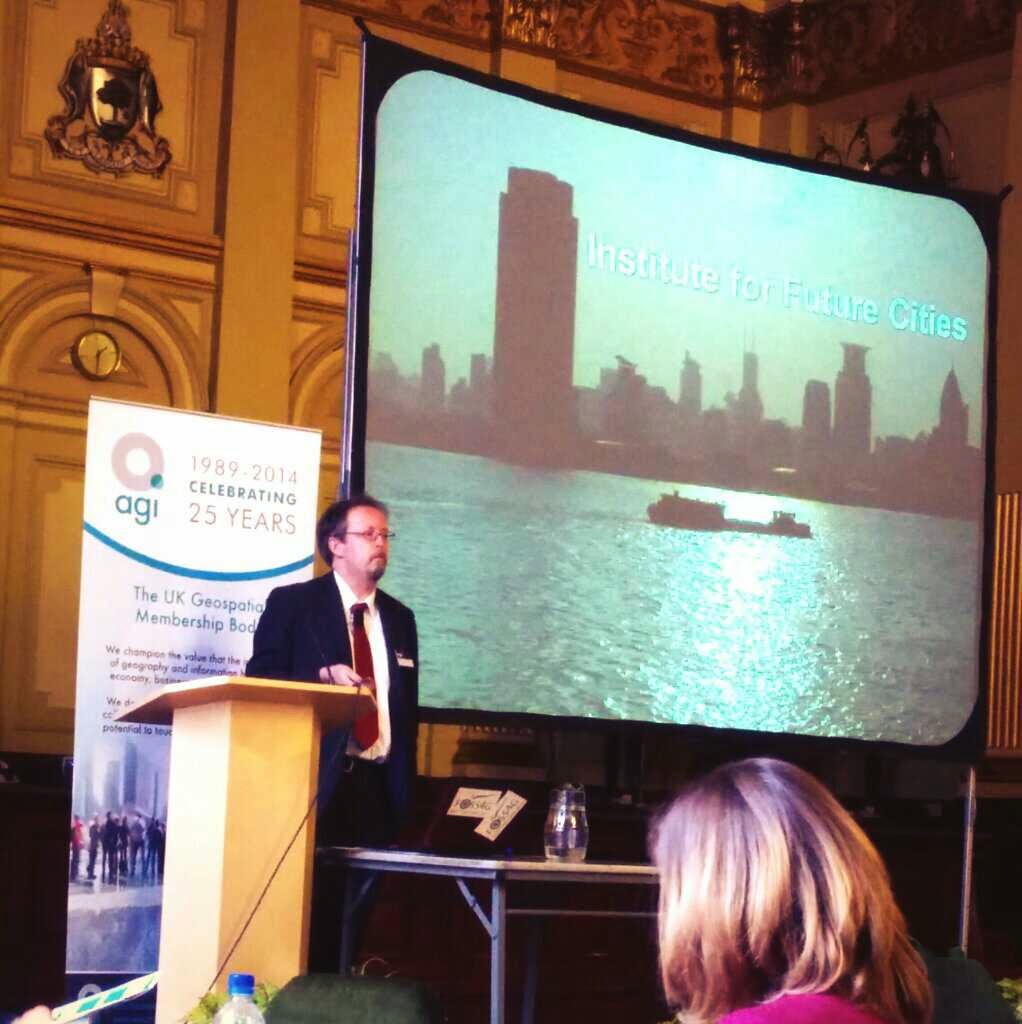
Institute of Future Cities
An interesting point made was that these problems have not just be realised – the concept of Future Cities was identified by 50 urban scientists meeting in 1960's US and outlining the issues of 'regeneration of cities needed to keep pace of demand’.

The plenary led into the Future Cities Steam which was chaired by Graham Colclough. A surprising thing about these sessions was the strength of continuity of the message between speakers. There was limited disagreement about the scope and scale of the problems being addressed by the Future Cities concept nor, the fact that location based data had an important role to play in tackling these problems. What was perhaps more surprising was that the focus of the discussions was entirely on the value of using geospatial thus we did not hear about how an application was developed and deployed, but about the reasons that they were developed, the success of the uptake, and the outcomes.

Steven Revill (Future Cities Glasgow) started the Future Cities session with a fuller review of the work already referenced by Councillor Matheson. The Open data market to “empower Glasgow” was a prominent thread of the discussion. This was achieved through the web portals and out outlets such as the My Glasgow Apps. In regard to adoption of the services, Steven reflected on how useful the branding had been to engage to younger audience, as was the premise of presenting data stories. The platform itself is developed quickly with releases often made in an attempt to maintain momentum to the project. The search for new data is on-going with GCC energy consumption of all public sector and education buildings being the latest. This has enable people to scrutinise energy use putting buildings that use excessive energy in the public eye and driving change

A question from the floor raised the issue of data quality. Apparently operational data from GCC is good, but there is discrepancy and an issue with completeness. However publishing the data is helping address and potentially resolving this problem. Making it public is driving a change in behaviours.

Dr Diarmad Campbell (British Geological Survey) had a very different focus, and that is the sub-surface. BGS have an Urban Strategy for the simple reason that 80% of the population live in such areas, and therefore the activity that requires geological analysis (structures) is concentrated in these areas. While internationally other cities such as Oslo and Amsterdam have huge investment in understanding the underground, in the UK there has not been such a history of investment. BGS are now working with GCC to produce a complete and detailed model of the sub-surface. Many urban areas, not least Glasgow have a complex sub surface environment from legacy industry as well as industrial processes and BGS are driving towards multi channel data availability to allow for better provision and better decision making.

George Kirk from Scottish Power Energy Networks discussed integrated energy planning, that is dealing with power from station to the plug. He explained how low carbon is a key part of Glasgow City development but has so far no being tackled fully. Previously there has been no shortage of data, but a limited understanding of how we use that data to make decision. Now there is an opportunity to inform the profession and public alike through visualisation and data availability

The afternoon session moved the focus of the discussion from Glasgow and the UK to the global context, and this was kicked off by Richard Bellingham (Institute for Future Cities, Strathclyde University) by presenting the issues of the changing world and in particular a growing and aging urban population. These are challenges that cities have no control over but cities are required to respond to them.

The scale of the problem is immense, billions of people moving to cities in the coming decades – which are creating patterns of mega-cities across the world. However we have to consider that this migration is a voluntary process. Cities are desirable places to live. They also act as engines for economic development and offer a solution to our energy crisis in that they are also more efficient per head on almost every measure.
Teresa and the Future Cities Catapult

Finally Teresa Rico Gonzales (Future Cities Catapult) rounded the session off with the work that the TSB is funding through the Catapult in order to mitigate the vast challenge of rural to urban migration. However she was keen to stress that the FCC is not reinventing the wheel but looking to utilise the expertise that is out there and enable collaborative creation of the solutions, a common them across the afternoon’s speakers.

The motivations of the FCC are focused on particular outcomes; the primary is a duty of care (as a remit of the TSB funding), but other more tangible (and commercial) targets are related to generating exportable urban innovations, growing UK market share of the global Future Cities potential and to build a world-class urban cluster.

The session was rounded up with a panel discussion led by Graham Colclough with:

The Panel
Richard, Teresa, Diarmad, Steven and Rollo Home on the stand. Graham encapsulated the discussion as revolving around two basic principles of information/data and collaboration which was re-iterated by the panel speakers, but each presented their own perspective on the problem with the Ordnance Survey and BGS looking at this from the position of having data to offer but needing to work with cities to understand the nature of the requirement, and with cities working with academia to understand the actors driving change and their requirements for data to monitor and support those agents. 

Thursday, 20 March 2014

Geo: The Big 5 gets underway!


Not a bad turnout...
Yesterday AGI Scotland hosted Future Cities the first of the Geo Big 5 events series and I'm pleased to say that we've got off to a flying start. Delegate turnout was at pre recession levels, the speakers were fantastic and the venue was pretty spectacular (thanks to Glasgow City Council for that one). Both streams had a really solid line up of presentations and the panel debate in the afternoon was really well received (those can be tricky to pull off).

I spent the day room monitoring in the best practice stream so I will be getting one of my colleagues to write a summary of that soon. In the meantime this’ll be a brief round up of the sessions I saw which included some great pieces of innovation.

The event opened with some very encouraging comments from the head of Glasgow City Council, showing that the local authority has really understood the power of GI to improve services for the citizen. However I will let my colleague cover this more within the context of the future cities stream.

The Main Room/Palace
The morning best practice stream opened with a presentation from the Forestry Commission Scotland on releasing a Scotland wide dataset on native woodland. This was quite an ambitious project in scope with the whole of Scotland surveyed over a period of about six years (some areas surveyed in greater detail based on aerial imagery). After collecting this huge dataset the team then overcame a number of challenges to provide this as open public data easily accessible to non GI users.

This was followed by a very nice presentation/demonstration from Paul Clarke of Esri on designing the future city. This showed City Engine being used on a range of projects as well as a general view on what future cities may look like. Paul also echoed the councillor’s comments about when talking about future cities it is what we are doing today that will define how they look and work.
The following presentation on the use of GI to support the Commonwealth Games in Glasgow gave a very practical demonstration of the challenges a modern city faces and the tools we have to overcome them.

After lunch the best practice stream kicked off with a really interesting project from Ross McDonald and Angus Council. They had successfully evolved their geospatial offering from a truly Byzantine collection of different platforms, datasets and file types into a much more open focused and integrated set up. This has allowed them to free up powerful but expensive proprietary software for users who most need it whilst spreading the power of spatial much wider across the organisation. Their mantra appropriately is ‘spatial isn’t special, its core’.

A presentation by ERM showcasing the use of GI for environmental and social management of major projects was up next. A particularly interesting feature of this solution is that it is accessible via the web and allows users (such as local residents) to comment on features of a project.

Last but not least Scottish Water and Kemeling Consulting presented on an asset visualisation project they have been working on. This project allows much better visualisation of sections of the Scottish Water network allowing the double benefit of improved repair efficiency and also improved transparency with local communities as to why work is being undertaken. The project has so far informed around £1 million worth of repair work.


An overall theme coming out of this stream, particularly the afternoon sessions was that the next step for cementing the role of spatial is to be able to articulate hard financial savings from projects such as these. All the users know there was benefit and the challenge is to be able to express this financially, something that is particularly crucial as the use of spacial spreads into the private sector.

Monday, 10 March 2014

Future Cities – It’s Nearly Time


We’re living in a time of rapid urbanisation, where shifting global demographics (growing in number, age and prosperity as they migrate from rural to urban life styles) are going to have an increasing impact on our activities here in the UK. For London, the population will grow to 9M by 2021 and 10M by 2030. That brings with it considerable pressures – for example, the need for 800K extra house units, capacity for an additional 600K peak-time commuters, and the challenge of dealing with the increased waste and energy consumption.  The Future or Smart City is the collective response to these immense challenges. It is not one thing or one technology, but a proactive approach to managing the urban infrastructure to provide a better level of service and living with less available resources.

It’s just over a week to go until the first of the Geo Big 5 events. This will be the Future Cities conference hosted by AGI Scotland in Glasgow. We’ve got strong delegate numbers and are still getting sponsors joining at this stage. More importantly (to our delegates anyway) we have a great line up of speakers which can be seen here.

Professor Iain Stewart
Highlights from this include a plenary from Professor Iain Stewart, BBC staple and geologies’ ‘rock star’ (Not my pun). In the Future Cities stream we have presentations from the Greater London Authority, the Glasgow Future Cities team and the Institute for Future Cities among others. The case studies stream has some great projects from geospatial in Scotland including the Forestry Commission and the Commonwealth Games (quite appropriate as today is Commonwealth Day). The Future Cities stream also includes a panel debate with some of the day’s speakers and a few special guests.

Anyway with all that in mind I thought I’d give a quick background on Future Cities and why we have picked this as one of our big 5 for 2014.


Andrew Collinge
Andrew Collinge - Greater London Authority
This event, being held in the impressive Glasgow City Chambers, will enable delegates alike to come away with a renewed appreciation of how Geospatial Information and Systems (GIS) can contribute to overcoming the barriers of a City becoming a Future City. To understand a modern city is to understand how its occupants utilise the space over time. However much of the discussion around future solutions to meet the increased and changing demands being placed on a city, are not addressing the inherent geographic nature of the problem. This is perhaps being exacerbated by the GI industry not sufficiently articulating the benefits it can bring. This events aims to provide an awareness to all attendees of the opportunities offered by making GI an integrated part of the Future Cities solution.


It’s going to be a great event and a must attend if you are interested in Future Cities, you can book here. Flights to Glasgow are still pretty cheap and it’s only £49+VAT for members.